


Safe Work Practices
There are 3 sets of standards and regulations that govern safe work practices in proximity to power lines in Texas - Occupational Safety and Health Administration (OSHA), the American National Standards Institute (ANSI), and the Texas Constitution and Statutes. The table below provides a comparison of OSHA’s federal regulations, ANSI’s industry accepted standards, and Texas state law that apply to contractors performing line clearance work for TNMP.
Aspect | OSHA 1910.269 | ANSI Z133.1 | Texas Health and Safety Code - |
Purpose | Federal regulation for electric power generation, transmission, and distribution safety, including line-clearance tree trimming near energized conductors. | Industry consensus standard for arboricultural operations, covering all tree care safety practices including electrical hazards. | State law to protect workers and the public from hazards near high-voltage overhead lines by regulating activities within clearance zones. |
Scope | Applies to qualified employees working on or near electric power lines and equipment (including line-clearance arborists within 10 ft of energized conductors). | Applies to all arborists and tree care workers, regardless of proximity to energized lines. | Applies to any person or entity performing work within 6 feet of overhead lines exceeding 600 volts, unless exempt (e.g., utility employees). |
Training Requirements | Employers must certify training for employees working within 10 ft of energized conductors; includes hazard recognition, MAD, PPE, and emergency response. | Requires all employees to be trained to recognize electrical hazards and follow safe work practices; aligns with EHAP. | No formal training requirement; focuses on notification and clearance compliance. |
Minimum Approach Distance (MAD) | Specifies MAD based on voltage and conditions; only qualified workers may approach closer than MAD. | Requires compliance with OSHA MAD for electrical hazards; emphasizes hazard recognition and avoidance. | Prohibits work within 6 feet of high-voltage lines without prior arrangements. |
Electrical Hazard Focus | Detailed requirements for line-clearance arborists and utility crews; prohibits unqualified workers from entering MAD. | Requires all arborists to be trained in electrical hazard recognition; EHAP training satisfies ANSI Z133 electrical safety requirements. | Focuses on physical clearance and notification, not technical work practices. |
Enforcement | Enforced by OSHA; violations can result in citations and penalties. | Voluntary compliance; often adopted by companies and referenced in contracts and litigation as industry best practice. | Enforced by Texas law; violations can result in criminal penalties and liability for damages. |
Downed Power Lines
NEVER approach a downed power line or ANY OBJECT near a downed power line. Immediately report any downed power lines to TNMP (888/866-7456).
Contact TNMP
NEVER prune or remove trees near power lines. TNMP contracts with tree companies that are qualified to perform arboricultural activities near power lines. They are trained in operations that follow the OSHA and ANSI industry standards, which include minimum distances from power lines required based on the voltage.
Requests regarding trees near power lines submitted online will be assessed within 5 business days; However, if this is an emergency, a tree has fallen on a power line for example, please contact TNMP at 888/864-7456.
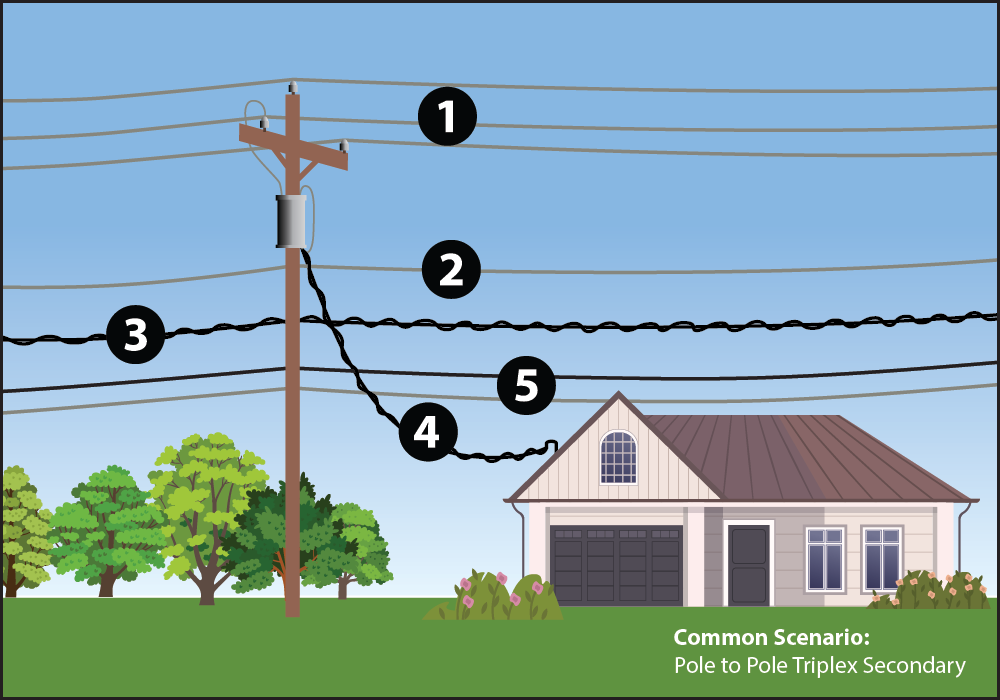
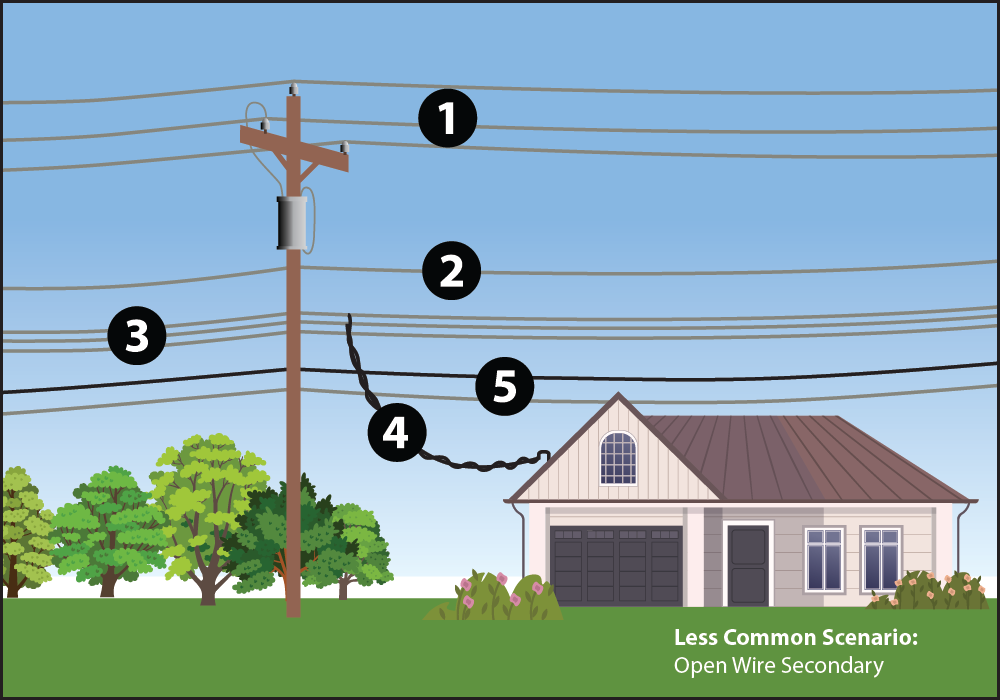
To better identify the different wires you might see, please refer to the pictures above and the following descriptions. TNMP’s priority is keeping vegetation clear from primary and secondary conductors, and neutral wires. Unless the vegetation presents an imminent threat, TNMP will typically defer the request to align with scheduled proactive maintenance.
- Primary Power Lines - attached to the top of a pole or crossarm, these lines carry higher voltage electricity over longer distances
- Neutral Lines – located below the primary conductors, this line helps stabilize the distribution system and offers protection to the energized conductors from fault currents; in some cases, the neutral line can be located on top of the pole above the primary power lines
- Secondary Power Lines – located below the system neutral, these lines carry lower voltage over shorter distances and can be found in a wrapped configuration referred to as Triplex or in a vertically stacked ‘open wire’ configuration
- Service Drop – delivers electric service to a home or business and can originate at the pole (most common) or mid span from the secondary wires | property owners have the primary responsibility to keep vegetation clear of these lines, and you should contact TNMP to request a temporary disconnect if you need to maintain any vegetation near the service line
- Communication Lines | TNMP is not responsible for the maintenance of communication lines; you should contact the local communication company for any concerns about vegetation impacting these lines