


It is important to know where underground utilities are located before planting a tree, shrub, or garden plant. The Texas One Call Law requires anyone in Texas planning to dig or disturb the ground to first notify a certified one-call center to mark underground utility infrastructure.
Either call 8-1-1 or visit https://texas811.org at least 2 business days in advance of any planned ground disturbance.
Trees are Resources
Trees are resources integral to our quality of life, but they can interfere with another crucial resource we all depend on – electricity. During severe weather events, tree limbs can fall on power lines and cause outages. When trees and power lines connect, there are serious safety risks:
- Branches that fail can cause high voltage power lines to fall to the ground creating an electrocution hazard to anyone in the area
- Trees that grow near power lines can make it all too easy for a child climbing the tree to come in contact with power lines
At TNMP, we strive to balance our commitment to environmental stewardship, with our responsibility to provide a safe, reliable source of power for our customers around Texas.
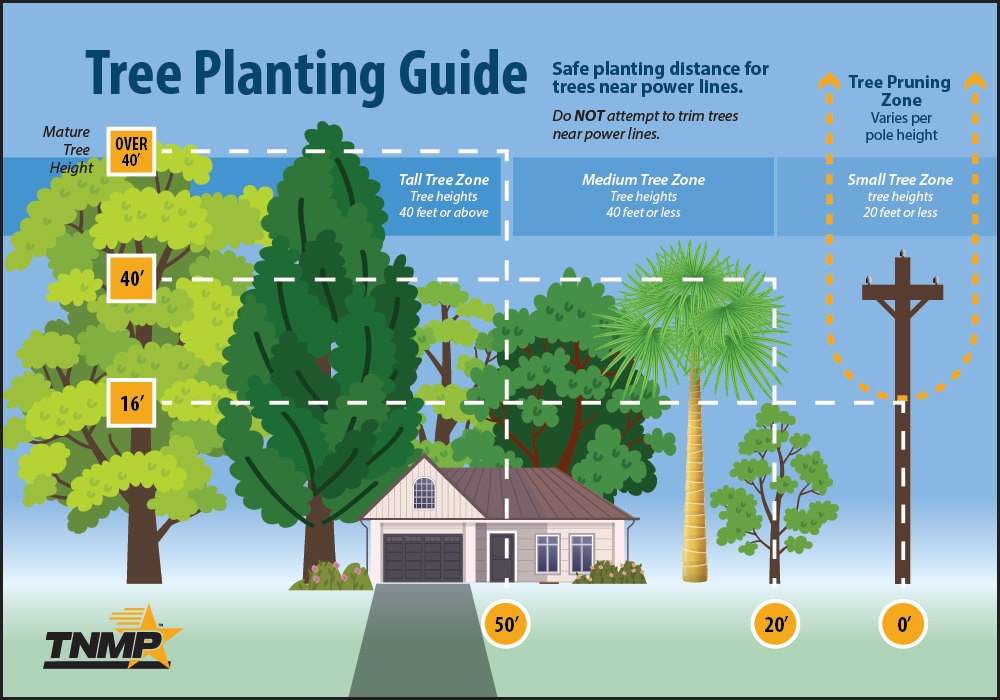
You can help by making sure any new trees that you plant will not interfere with any power lines or utilities on your property. The following information is intended as a guide to help you plan and plant trees that will be beautiful, healthy, and safe from seed to shade, Selecting the Right Tree for the Right Location.
TNMP recognizes that trees are a valuable part of our ecosystems and supports various tree planting efforts throughout the communities we serve. While planting trees is critical to maintaining vibrant urban and community forest resources, it is important to select the right tree for the desired location.
Selecting the Right Tree for the Right Location
There are a few simple rules to follow when deciding where and what to plant:
- Know the mature height and spread of the tree species you want to plant
- Pay attention to overhead electric lines and other potential conflicts (underground utilities, streetlights, traffic signs, buildings, sidewalks, etc.)
- Consider the potential energy saving benefits of maximizing shade coverage based on the location of the sun throughout the day and the sun’s movement during various times of the year
Tree Species Considerations
In addition to selecting the right tree based on mature size and potential physical limitations and site conflicts, it is important to consider environmental suitability and appropriateness. Key factors include:
- General Characteristics – the tree you choose should match your expectations and work within your landscape; see tree selection guide for more information regarding shape, size, branching structure, flowering, fruit production, preferred sun exposure, drought tolerance, cold hardiness, etc.
- Water Use – water conservation is important in Texas and selecting trees with lower water requirements and high drought tolerance is a good measure of environmental awareness; however, if you have a site that is prone to flooding it is important to also consider a tree’s tolerance for periodic saturation.
- Climate Tolerance – consider Texas’ seasons, drought conditions, and abundant sunshine when you select a tree.
Invasive Species
Certain non-native tree species should be avoided because they are aggressive and have become invasive. This means they outcompete other species, often reducing biodiversity and altering habitats. The following table lists species by region that are considered invasive by the Texas A&M Forest Service. For more information, please visit: Invasive Plants & Trees - Texas A&M Forest Service.
|
Plant Name |
Texas Regions |
||||
|
Common |
Latin |
North |
Central |
South |
West |
|
Tree-of-Heaven |
Ailanthus altissima |
I |
I |
I |
I |
|
Mimosa |
Albizia julibrissin |
I |
I |
||
|
Paper Mulberry |
Broussonetia papyrifera |
I |
I |
||
|
Camphor Tree |
Cinnamomum camphora |
I |
|||
|
Russian Olive |
Elaeagnus angustifolia |
I |
|||
|
Chinese Parasoltree |
Frimiana simplex |
I |
I |
||
|
Leadtree |
Leucaena leucoephala |
I |
|||
|
Privets |
Ligustrum spp |
I |
I |
I |
|
|
Chinaberry |
Melia azedarach |
I |
I |
I |
|
|
White Mulberry |
Morus alba |
I |
|||
|
Princess Tree |
Paulownia tomentosa |
I |
|||
|
Chinese Pistache |
Pistacia chinensis |
I |
|||
|
Callery Pear |
Pyrus calleryana |
I |
|||
|
Brazilian Peppertree |
Schinus terebinthifolius |
I |
|||
|
Saltcedar |
Tamarix spp |
I |
I |
I |
|
|
Chinese Tallow |
Triadica sebifera |
I |
I |
||
|
Siberian Elm |
Ulmus pumila |
I |
|||
|
Vitex |
Vitex agnus-castus |
I |
|||
Trees to Avoid Planting in Texas
Professional arborists do not recommend planting the following trees in Texas. They have negative characteristics including excessive water usage, weak structures, and disease susceptibility.
Tree Selection |
Characteristics |
|
Ailanthus |
prolific seed and root sprouts which take over landscape, Emerald Ash Borer |
|
All N. American Ash |
weak-wooded, insect and disease problems, defenseless against Emerald Ash Borer |
|
Birch |
weak structure, insect, and disease problems |
|
Black Locust |
prolific root sprouts |
|
Boxelder |
weak structure, insect problems |
|
Bradford Pear |
weak structure, prone to storm damage |
|
Chinese Tallow |
weak-wooded, insect and disease problems, short-lived |
|
Hackberry |
weak-wooded, short-lived |
|
Mimosa |
weak-wooded, short-lived |
|
All Poplars |
weak structure, short-lived, susceptible to storm and ice damage, attracts borers |
|
Russian Olive |
fast grower that uses lots of water, short-lived, disease problems |
|
Saltcedar |
fast grower that chokes out waterways and desirable vegetation |
Tree Selection Guide
The following is a list of recommended tree species for planting in Texas.
Tree Selection |
Hardiness Zone |
Mature Size |
Water Usage |
|
Afghan pine – Pinus eldarica |
6 to 9 |
30 – 50' |
High |
|
American elm – Ulmus americana |
2 to 9 |
60 – 90' |
Medium |
|
American plum – Prunus americana |
5 to 9 |
12 – 20' |
Medium |
|
Apples & crabapples – Malus spp. |
3 to 8 |
10 – 20' |
Med – High |
|
Atlas cedar – Cedrus atlantica |
7 to 10 |
50' |
Medium |
|
Bur oak – Quercus macrocarpa |
3 to 8 |
50 – 80' |
Medium |
|
Carolina buckthorn – Rhamnus caroliniana |
6 to 9 |
10 – 30' |
Low – Med |
|
Catalpa – Catalpa bignonioides |
6 to 10 |
30 – 40' |
Medium |
|
Cedar elm – Ulmus crassifolia |
6 to 9 |
80' |
Medium |
|
Chinquapin oak – Quercus muhlenbergii |
5 to 9 |
40 – 60' |
Medium |
|
Chitalpa – Chitalpa tashkentensis |
8 to 11 |
30' |
Low – Med |
|
Deodar cedar – Cedrus deodar |
7 to 10 |
50' |
Medium |
|
Desert willow – Chilopsis linearis |
7 to 10 |
20' |
Low |
|
Eastern cottonwood – Populus deltoides |
2 to 9 |
75 – 100' |
Med – High |
|
Eastern redcedar – Juniperus virginiana |
2 to 9 |
30 – 40' |
Low |
|
Eastern redbud – Cercis canadensis |
4 to 9 |
25' |
Low – Med |
|
Fringetree – Chionanthus virginicus |
6 to 9 |
15 – 30' |
Medium |
|
Gambel oak – Quercus gambelii |
4 to 8 |
15 – 20' |
Low |
|
Ginko (male) – Ginko biloba |
3 to 8 |
70' |
Low – Med |
|
Goldenrain tree – Koelreuteria paniculata |
5 to 9 |
30 – 40' |
Low |
|
Hawthorn – Crataegus spp. |
4 to 8 |
25' |
Low – Med |
|
Honeylocust – Gleditsia triacanthos |
4 to 9 |
50' |
Low – Med |
|
Horsechestnut – Aesculus hippocastanum |
4 to 7 |
50' |
High |
|
Incense cedar – Calocedrus decurrens |
5 to 8 |
30 – 70' |
Low – Med |
|
Japanese pagoda – Sophora japonica |
4 to 8 |
25' |
Low |
|
Kentucky coffee tree – Gymnocladus dioicus |
3 to 8 |
50' |
Low |
|
Lacebark elm – Ulmus parvifolia |
4 to 9 |
40 – 50' |
Medium |
|
Littleleaf linden – Tilia cordata |
3 to 7 |
60' |
Medium |
|
Live oak – Quercus virginiana |
7 to 10 |
40–80' |
Medium |
|
London planetree – Platanus x acerifolia |
5 to 9 |
75 – 100' |
Medium |
|
Loquat – Eriobotrya japonica |
7 to 10 |
10 – 20' |
Medium |
|
Magnolia – Magnolia spp. |
3 to 10 |
15 – 80' |
Low – Med |
|
Mexican buckeye – Ungnadia speciosa |
8 to 10 |
10 – 20' |
Low – Med |
|
Mexican elder – Sambucus mexicana |
7 to 10 |
15 – 25' |
Medium |
|
Mexican plum – Prunus mexicana |
6 to 9 |
15 – 25' |
Low – Med |
|
Newport plum – Prunus cerasifera 'Newport' |
4 to 9 |
15 – 25' |
Medium |
|
Peach – Prunus persica |
5 to 8 |
15 – 25' |
Medium |
|
Pecan – Carya illinoiensis |
5 to 9 |
70' |
Medium |
|
Pink flowering locust – Robinia x ambigua |
4 to 8 |
25 – 40' |
Low |
|
Piñon pine – Pinus edulis |
6 to 8 |
10 – 20' |
Low |
|
Possumhaw holly – Ilex decidua |
6 to 9 |
15 – 20' |
Medium |
|
Purple-leaf plum – Prunus cerasifera |
5 to 8 |
15 – 20' |
Low |
|
River birch – Betula nigra |
4 to 9 |
40' |
High |
|
Roughleaf dogwood – Cornus drummondii |
5 to 9 |
15 – 30' |
Medium |
|
Rusty blackhaw – Viburnum rufidulum |
5 to 9 |
20' |
Low |
|
Saucer magnolia – Magnolia x soulangiana |
8 to 9 |
20 – 25' |
Medium |
|
Scotch pine – Pinus sylvestris |
3 to 7 |
50' |
Low |
|
Shumard oak – Quercus shumardii |
7 to 10 |
75' |
Low – Med |
|
Silver maple – Acer saccharinum |
4 to 8 |
60 – 80' |
Med – High |
|
Sumac – Rhus spp. |
4 to 10 |
10 – 20' |
Low |
|
Texas live oak – Quercus fusiformis |
7 to 10 |
20 – 50' |
Low |
|
Texas madrone – Arbutus texana |
7 to 10 |
20 – 30' |
Low |
|
Texas mountain laurel – Sophora secundiflora |
8 to 9 |
5 – 20' |
Low – Med |
|
Texas red oak – Quercus buckleyi |
5 to 9 |
30' |
Low |
|
Umbrella catalpa – Catalpa bungei |
4 to 8 |
50' |
Low |
|
Wax myrtle – Myrica spp. |
7 to 10 |
5 – 20' |
Low |
|
Weeping willow – Salix babylonica |
4 to 9 |
50' |
High |
|
Western catalpa – Catalpa speciosa |
4 to 8 |
50' |
Low |
|
Yaupon holly – Ilex vomitoria |
7 to 9 |
10 – 20' |
Low – Med |
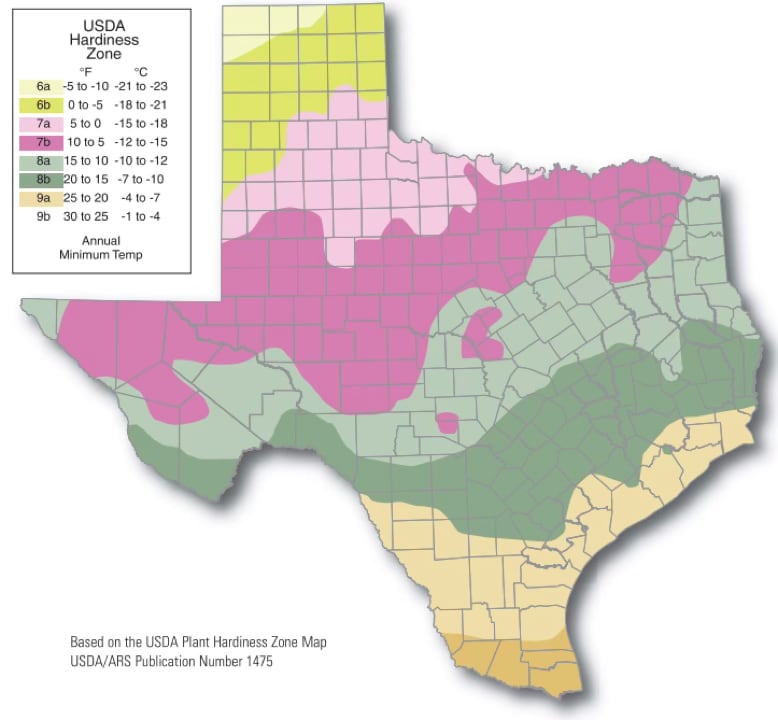
USDA Hardiness Zone
Below is a state map identifying the hardiness zone(s) and average annual minimum temperature range(s) for each county.
How to Find a Professional Arborist
An arborist is a tree care specialist. Hiring an arborist to help maintain your trees is an investment that can result in attractive, healthy trees. How do you choose an arborist?
- Ask friends and neighbors for recommendations
- Call tree care companies and learn about their pruning and maintenance techniques
- Check to see if an individual is a Certified Arborist through the International Society of Arboriculture (ISA) – ISA does not certify companies, only individuals
- Ask companies for local references
- Request proof of insurance from any company you hire
- Get a contract stating the project scope and the price
- NEVER attempt to trim trees near power lines
Find a Certified Arborist
The ISA maintains a database of Certified Arborists: www.treesaregood.com
Learn More About Trees
Below are links to relevant industry resources:
Public Utility Commission of Texas
https://ftp.puc.texas.gov/public/puct-info/consumer/facts/factsheets/elecfacts/trees.pdf
https://ftp.puc.texas.gov/public/puct-info/agency/rulesnlaws/subrules/electric/25.96/25.96.pdf
Texas A&M Forest Service
https://tfsweb.tamu.edu/trees/
The National Arbor Day Foundation
https://www.arborday.org/planning-selection-location
https://www.arborday.org/planting-your-tree